
Immersive Walk or a History Lecture walk?
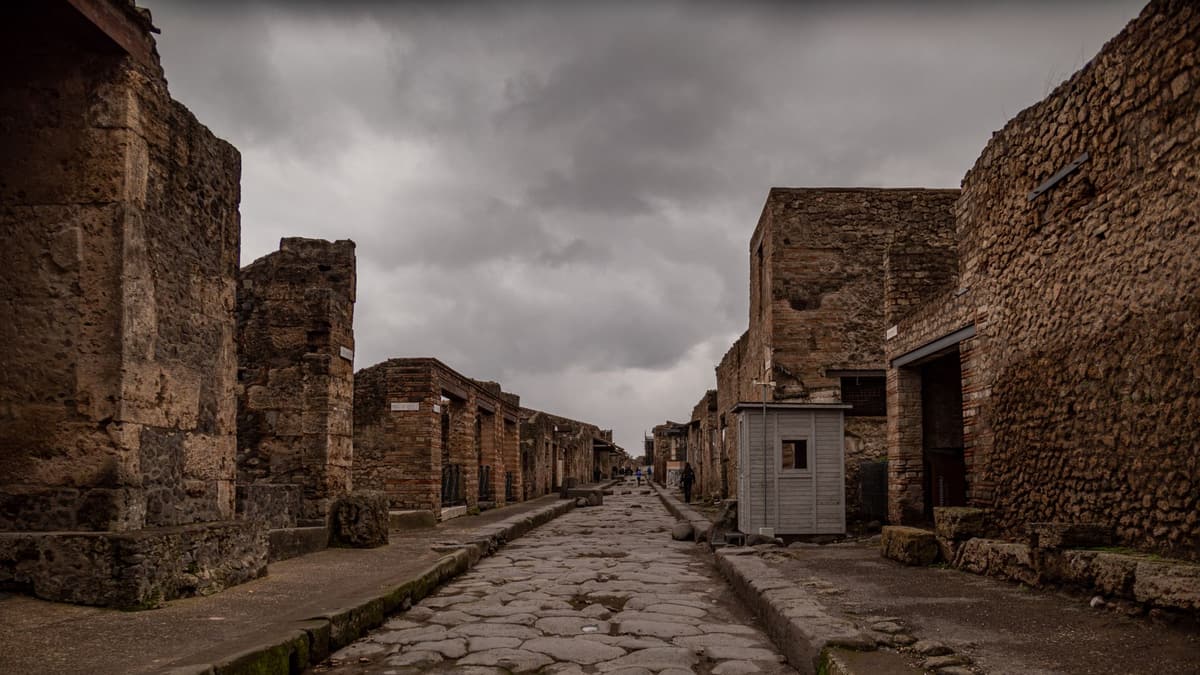
On the morning of 15 March 44 BC, Julius Caesar passed a seer on his way to the senate and joked, in Plutarch's telling: "Well, the Ides of March are come." The seer answered: "Ay, they are come, but they are not gone." The night before, his wife Calpurnia had dreamt of holding his body and begged him to stay home. He nearly did. A friend who was in on the plot talked him out of it.
Shakespeare kept the exchange almost word for word in Julius Caesar, more than sixteen centuries after the event. "The ides of March are come." "Ay, Caesar, but not gone." Most of us know the warning from his play rather than from Plutarch: "Beware the ides of March."
The meeting that day was not in the Forum. It was in a hall attached to Pompey's theatre, and what's left of it lies below street level at Largo di Torre Argentina, a sunken square of temples and sleeping cats beside a busy tram and bus stop.
You can take that in two ways. Someone can tell you about it: the date, the conspirators, the politics, the aftermath, in order, while you wait for the group to move on. Or you can stand at the railing, look down at the stones, and spend two minutes inside that morning, reliving and revisiting the exact spot where Julius Caeasar was harbingered of his fate.
The first is a history lecture wawlk. The second is an immersive walk. The facts are the same. Only one of them tends to come home with you. Here in Walk With Me, we provide you with a high quality immersive walk that helps you see the city yon a layer never seen before.
A lecture hands you facts. A moment puts you somewhere
The difference is where your attention points. A lecture points it at the speaker and at the timeline. You're asked to hold names, dates and causes in your head, often while standing in a crowd, looking at the back of someone's jacket. You can follow every word and still not look at the place once. If I go to Rome to enjoy the remanents of the most powerful country in antiquity, and someone is naming the dates, the names, and random events that happened in the course of said country, I would check out of the tour before it starts; a part of me years for time traveling, and standing where someone else stood a few millennium ago would be the closest thing to that. I'd rather someone told me the details of how it went down, its particularities...etc.
A moment points your attention at the place. This wall, this corner, this hour. Instead of "Caesar was assassinated in 44 BC by a group of senators", you hear what that morning was like, and your eyes do the rest of the work. The stones in front of you become the set. From a tourist's side, the test is simple. A week later, can you picture the spot? After a lecture, you usually remember that you were told something. You studied something, just like in school, or university; you're traveling to relax and explore, not to be lectured, correct?
What the Stoics said about sightseeing
Seneca would have had little patience for a day of ticking off sights. In Letter 28, a friend complains that long travel hasn't lifted his gloom. Seneca's answer, in Richard Gummere's translation: "You need a change of soul rather than a change of climate." Then, harder: "What pleasure is there in seeing new lands? Or in surveying cities and spots of interest? All your bustle is useless." He borrows Socrates' reply to the same complaint: "you always take yourself with you."
It isn't an argument against travel. It's an argument against travel as rushing. In Letter 2 he puts it in three words: "Everywhere means nowhere." Twelve sights in a day, each half-seen, is the tourist's version. In Letter 1 he gives the cure: "hold every hour in your grasp", because "while we are postponing, life speeds by."
Marcus Aurelius, writing notes to himself, kept returning to the same point. In George Long's translation: "every man lives only this present time, which is an indivisible point, and that all the rest of his life is either past or it is uncertain." And in Book Two: "the present is the only thing of which a man can be deprived."
Epictetus has the line I'd pin to every holiday. In Discourses 4.12, an imagined listener says he'd rather play today. The reply: "Well then, ought you not to play with attention?" A day off is not a day off from noticing.
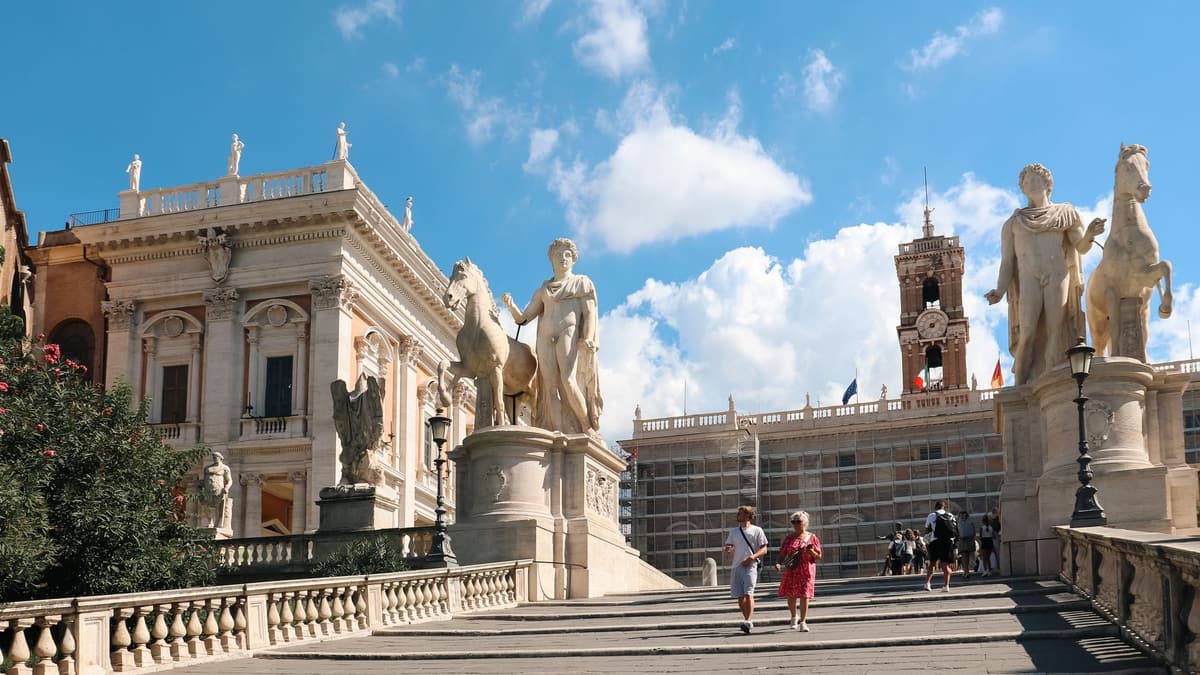 Castor and Pollux at the top of the Capitoline steps, Rome
Does history help you be in the moment, or pull you out of it?
It sounds like a contradiction. The Stoics want you here, now. A history walk is about then.
The way out is where you are standing. Thinking about the Ides of March on your sofa is thinking about the past. Standing at Largo Argentina, looking at the actual stones while you hear about that morning, is something you're doing now, with your eyes and your feet. The past stops being a list of dates in your head and becomes something in front of you.
A lecture keeps history abstract: you're thinking about it. A moment at the spot makes it concrete: you're noticing it. Only the second fits Marcus's "indivisible point".
Walking meditation does the same thing on foot
Walking meditation is the same habit on foot: you walk slowly enough to notice each step, the ground under you and the sounds around you, and when your mind drifts you bring it back to where you are.
An audio walk isn't meditation. There's a voice telling you a story, and your mind goes where the story goes. What it can share with meditation is the posture underneath: on purpose, in this place, at this minute, eyes up.
 A Berliner Mauer marker post at Potsdamer Platz, Berlin
What the research says about attention, walking and memory
Your mind is somewhere else about half the time
Matthew Killingsworth and Daniel Gilbert built an iPhone app that asked 2,250 adults, at random moments, what they were doing, what they were thinking about and how happy they were. People's minds were on something other than what they were doing 46.9% of the time, and they were less happy while their minds wandered. A time-lag analysis suggested the wandering tended to come before the unhappiness rather than after (Science, 2010). Limits: volunteers, self-reports, about three in four of them American. Still, it puts a number on what Seneca was complaining about.
A walk's effect depends on where you walk
Gregory Bratman and colleagues sent 38 healthy adults on a 90-minute walk, either through green land near Stanford or along a busy road. The nature walkers reported less rumination afterwards (repetitive negative thinking about yourself) and showed less activity in a brain area linked to it. The road walkers showed no such change (PNAS, 2015). It's one small study in healthy people, and a busy road isn't an old town lane. What it doesn't show is that any walk clears your head. What it suggests is that the setting, and what it gives your attention, matters.
Why museums can wear you out
Stephen Kaplan's attention restoration theory (1995) separates directed attention, the effortful kind you use to follow a lecture or a train timetable, from the easy fascination a setting can hold without effort. Directed attention tires. Settings rich in easy fascination let it recover.
An earlier paper by Kaplan and colleagues (1993) asked why museums, full of fascinating objects, "often seem tedious and tiring". In surveys of 124 museum visitors, the museum looked like it could be restorative, but mostly for people already comfortable in museums. My reading, not theirs: a long run of facts asks for directed attention, the kind that tires, while a place in front of you can hold you without effort. A lecture-style tour spends the first. A moment at the spot leans on the second.
The phone in your hand changes what you remember
Linda Henkel had students take a guided tour of an art museum, photographing some objects and only looking at others. The next day, they remembered fewer of the objects they had photographed, and fewer details about them. When they zoomed in on one part of an object instead, the effect disappeared (Psychological Science, 2014).
Diana Tamir and colleagues ran similar tests with TED talks and a self-guided tour of a church on Stanford's campus. People who took notes, recorded or shared the experience did about 10% worse on later memory tests, and it didn't change how much they said they enjoyed it (Journal of Experimental Social Psychology, 2018).
Daniel Schacter's 2021 review adds the honest caveat: the effect depends on why you take the photo and what kind of memory is tested. The phone doesn't ruin a trip. Handing the experience to the phone, instead of looking, seems to cost you some of it.
How a well-made audio walk keeps you in the moment
When I decided how Walk With Me's tours would work, these were the choices that mattered most for presence. You can use them to judge any audio walk, ours or not.
- The story is told at the spot. Each stop is where the thing happened, so you look at what you're hearing about. On our Rome Ides of March walk, Largo di Torre Argentina is one of eight stops, between the Theatre of Pompey and the Theatre of Marcellus.
- Stories are short. Each stop is a minute or two. Short enough that your eyes stay on the place and you don't drift into the "later" pile.
- You don't read. Near each stop, about 100 m away, the app plays a soft chime, or sends a notification if it's in the background, and you tap to listen. The phone can go straight back in your pocket.
- No transcript on screen. I left out a read-along during the walk on purpose. Immersion is our first priority, and text on a screen pulls your eyes off the street, which is the one place they should be.
- One walkable line. Routes run in one line, usually 5 to 9 stops a few minutes apart, so there's no doubling back and little map-checking between stops.
- The audio is already on your phone. Tours you own download, so the stories play without a signal. The street map still needs a connection, so keep a little data for it.
The point of all this is to relive one moment where it happened. In Pompeii, the Garden of the Fugitives is a stop on our Pompeii Last Day walk, where you stand among the casts of people caught by the eruption of AD 79. In Berlin, the Peter Fechter Memorial marks where an 18-year-old was shot at the Wall on 17 August 1962 and lay in the border strip for about 50 minutes without help. Our Anne Frank walk in Amsterdam ends at the Anne Frank House. None of those needs a lecture. They need you there, looking.
Walking together without talking over the moment
A group tour shares the moment by putting everyone in front of one speaker. An audio walk can share it a different way.
In Walk With Me, people walking together hear the same stop at the same moment, each on their own phone, and each can pick their own narration language: English, German, French, Spanish, Japanese or Arabic, though not every tour has all six. Nobody has to translate for anyone, nobody leans over one screen, and when the story ends you're all looking at the same wall, which is a good moment to talk about it.
Seven habits for a walk where history happened
- Download the tour on Wi-Fi the night before. Fiddling with a loading bar at the first stop is the fastest way out of the moment.
- Find the spot before you play the story. Look for a minute first. The story lands harder when your eyes already know the place.
- Wear one earbud, or none and a low volume. You stay part of the street, and it's safer.
- Keep the phone in your pocket between stops. The walk between stops is part of the place, not dead time.
- Take one zoomed-in photo after the story, not many during it. Henkel's zoom result suggests a focused photo of one detail costs you less than snapping the whole scene.
- Stay a minute after the story ends. That's when it settles. Seneca's "everywhere means nowhere" applies to stops, too.
- Read about it afterwards. Facts stick better when you have a place to hang them on.
When a lecture is the better choice
Sometimes you want the lecture, and that's fine. If you want to ask questions, argue a point or go deep on one period, a good human guide or a museum talk does what no recording can: it answers you. If you're studying a place for work or a course, a structured run of facts is the right tool.
For most travellers on most days, though, the goal is to have been somewhere, not to have been told about it.
The takeaway
- Pick the moment over the timeline. One scene at the spot beats a run of dates you'll forget.
- Keep your eyes off the screen. Short stories, a chime instead of a feed, no text to read.
- Stay after the story. The minute after it ends is the present the Stoics kept pointing at.
If you'd like to try a walk built this way, Walk With Me is free on the App Store and Google Play, with more than 280 self-guided audio walking tours in over 100 cities, and the intro and stop 1 of every tour are free in the app. Whatever you choose, I hope the next place you visit gets your full attention, and gives you a moment back.
Frequently asked questions
What is an immersive walking tour?
A walk that tells you one moment at the place where it happened, while you look at it, instead of a run of dates and background. The aim is that you feel you were there, not that you could pass a test.
Is an audio tour better than a guided history tour?
For being present at the spot, often yes: short stories, no group to follow, and you choose when to listen. For asking questions and going deep on one subject, a good human guide is better, because a recording can't answer you.
What did the Stoics say about living in the present?
Marcus Aurelius wrote that "every man lives only this present time, which is an indivisible point". Seneca told a restless traveller he needed "a change of soul rather than a change of climate", and Epictetus asked why anyone would play without attention.
Can a city walk be a walking meditation?
Not in the strict sense, because meditation keeps attention on your steps and breath rather than a story. The overlap is the habit underneath: knowing you are walking, eyes up, ears open, attention here and now.
Does taking photos make you remember less?
In some studies, yes. Henkel (2014) found students on a museum tour remembered fewer objects they had photographed whole, but zooming in on one detail removed the effect. Tamir and colleagues (2018) found people who recorded or shared an experience did about 10% worse on later memory tests.
How do I stay present on a self-guided history walk?
Download the tour before you go, find the spot before you play the story, keep your phone in your pocket between stops, and take one zoomed-in photo after the story rather than many during it.
Do I need to read about the history before an immersive walk?
No. A well-made walk gives you what you need at each stop. Reading after the walk often works better, because you then have a place to hang the facts on.
Sources
- Plutarch, Life of Caesar 63 to 64, trans. Bernadotte Perrin (Loeb, 1919), LacusCurtius
- William Shakespeare, Julius Caesar, Act 1 Scene 2 and Act 3 Scene 1 (Folger Shakespeare Library)
- Sovrintendenza Capitolina: Area Sacra di Largo Argentina (read Oct 23, 2026)
- Phys.org: Spanish researchers find the exact spot where Julius Caesar was stabbed (CSIC, October 2012)
- Seneca, Moral Letters to Lucilius, Letter 1, trans. Richard Mott Gummere (Loeb, 1917), Wikisource
- Seneca, Moral Letters to Lucilius, Letter 2, trans. Richard Mott Gummere, Wikisource
- Seneca, Moral Letters to Lucilius, Letter 28 (On travel as a cure for discontent), trans. Richard Mott Gummere, Wikisource
- Marcus Aurelius, Meditations, Book Two, trans. George Long, MIT Internet Classics Archive
- Marcus Aurelius, Meditations, Book Three, trans. George Long, MIT Internet Classics Archive
- Epictetus, Discourses 4.12 (On attention), trans. George Long, Wikisource
- Killingsworth and Gilbert, A wandering mind is an unhappy mind, Science 330 (2010)
- Harvard Gazette: Wandering mind not a happy mind (November 2010)
- Bratman et al., Nature experience reduces rumination and subgenual prefrontal cortex activation, PNAS 112 (2015)
- Kaplan, The restorative benefits of nature: toward an integrative framework, Journal of Environmental Psychology 15 (1995)
- Kaplan, Bardwell and Slakter, The museum as a restorative environment, Environment and Behavior 25 (1993)
- Henkel, Point-and-shoot memories: the influence of taking photos on memory for a museum tour, Psychological Science 25 (2014)
- Tamir, Templeton, Ward and Zaki, Media usage diminishes memory for experiences, Journal of Experimental Social Psychology 76 (2018)
- APS: How social media is hurting your memory (May 2018)
- Schacter, Media, technology, and the sins of memory, Memory, Mind and Media 1 (2021)
- Chronicle of the Berlin Wall: Peter Fechter